Peat-free potting soil agreements end with a hangover
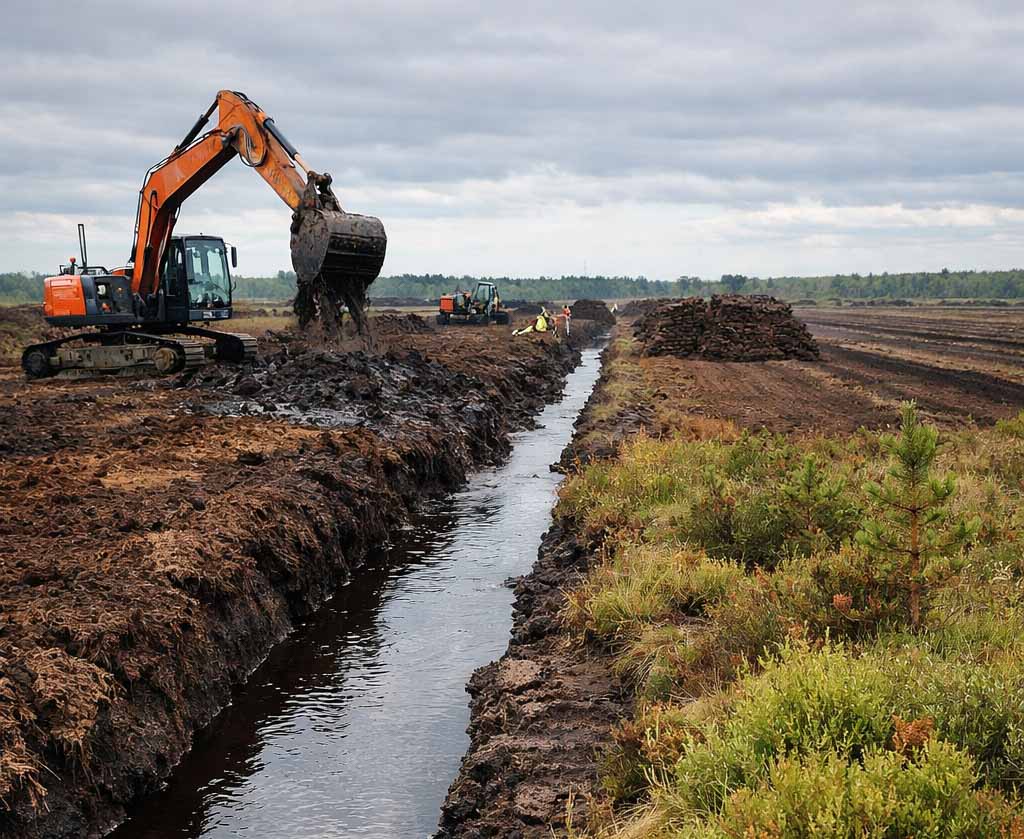
Peat extraction for potting soil production leads to high CO₂ emissions and the loss of biodiverse peat bogs. At the end of 2022, the potting soil industry, the government, and one small environmental organisation reached an agreement to address this. Three years later, Stichting Turfrvrij concludes: voluntary agreements are ineffective.
This is an unofficial translation by Stichting Turfvrij. The original article was written by Bart Crezee and published in Trouw, May 5th 2026.
Disappointed, Philipp Gramlich and Karin Bodewits made the decision last week. The two founders of Stichting Turfvrij are withdrawing from the covenant with the industry and the agreements to reduce the environmental impact of potting soil.
As a small environmental organisation, they spent three and a half years encouraging potting soil manufacturers to make their operations more sustainable. Now they conclude that this is impossible. They feel the collaboration is unbalanced. “It actually needed two or three environmental organisations at the table. It was us, as a tiny organisation, and then twelve parties representing the industry.”
It all started with good intentions. In the spring of 2021, momentum suddenly gathered. Gramlich and Bodewits, both experienced science communicators, approached the media with a clear message: peat-based potting soil is very harmful to the environment. Bodewits, trained as a biochemist, was surprised that most Dutch people don’t know that almost every bag of potting soil contains a piece of excavated natural material. In this case, it’s peat soil.
She submitted opinion pieces to newspapers and appeared on the radio. “We like to get worked up about the deforestation of the rainforest, but we don’t care about the ‘deforestation’ of peatlands in our own backyard,” she explained.
The media campaign was effective. Less than three months later, the House of Representatives adopted a motion with an overwhelming majority of 121 (>80%) votes to investigate how the use of peat in potting soil could be phased out. Only the PVV, FVD, Ja21, BBB, and MP Van Haga voted against. In November 2022, the motion led to the signing of the Environmental Impact of Potting Soil and Substrates Covenant, a voluntary agreement between the government and “a broad coalition of parties” to minimise the environmental impact of potting soil. The trade association of potting soil manufacturers, VPN, as well as representatives from agricultural and horticultural organisations, the floriculture sector, and the Ministries of Agriculture, Economic Affairs and Climate Policy, signed the covenant. Turfvrij, the foundation Gramlich and Bodewits had established in the meantime, joined as an independent environmental organisation.
More than three years on, the duo is withdrawing. “The fact that we’re sitting at the table with a party that still advocates for peat extraction is simply going too far. It’s completely against the agreements,” says Gramlich.
The Netherlands is dependent on peat
Peat, dried peat soil, has been used as fuel in the Netherlands for centuries. The last peat extraction on Dutch land occurred in 1992. However, our country still relies heavily on peat, especially in agriculture and horticulture, where it is a key component of growing substrates— the soil in which vegetables, flowers, and ornamental plants are cultivated. The Netherlands uses around 4 million cubic metres of peat each year, with over 85 per cent utilised by professional growers and breeders. The remaining amount is used for potting soil sold in hardware stores, garden centres, and supermarkets.
The vast majority of this peat mountain comes from the Baltic States and Germany, supplemented by small quantities from Scandinavia and Ireland. Unlike in the Netherlands, living peat is still drained and excavated in these countries.
This is despite the fact that peatlands are unique ecosystems that serve as vital water buffers. They host many endangered animal and plant species. At the same time, peat bogs store vast amounts of carbon in the soil – more than all forests combined worldwide. This carbon is released into the atmosphere as CO₂ when peat is drained for excavation. The Dutch potting soil industry claims to be responsible for approximately 0.5 percent of total national greenhouse gas emissions.
Philipp Gramlich and Karin Bodewits have been campaigning for a complete ban on peat use for several years. For a time, they believed they had momentum on their side. To showcase the widely supported motion by the House of Representatives, Stichting Turfvrij convened representatives from the potting soil and horticultural industries at the end of 2021. The idea of forming a convenant was soon suggested.
Lobby for more peat extraction in Europe
“We heard from the industry: let’s take a broader approach than a peat ban and discuss the environmental impact of potting soil,” Gramlich reflects. “I struggled with that, because that’s obviously easier to comply with.” Instead of banning peat entirely, the agreement urges participants to use more renewable raw materials, such as coir, wood fibre, or compost. Additionally, the peat still in use must be sustainably certified to ensure a “limited impact on local biodiversity and the environment.”
These less stringent agreements allow the most influential party at the table, the Vereniging Potgrond Nederland (VPN), to claim support for the agreement’s objectives while also lobbying for increased peat extraction in Europe.
In a recent lobbying paper, drafted last autumn in collaboration with its German sister organisation IVG, the VPN advocates for a simplification of environmental regulations surrounding peat extraction and use. The organisation complains that a “long-term, one-sided focus in Europe on reducing peat extraction” is endangering the entire sector. Additional peat extraction is necessary, among other things, for food security, writes the VPN, although its own figures show that less than a quarter of Dutch potting soil is used for fruit and vegetable production. Gramlich claims the lobbying paper was, among other things, submitted by an Estonian peat extraction company to obtain extraction rights for a still-untouched raised bog area.
The agreements are unenforceable
According to Stichting Turfvrij, a phase-out process for peat cannot be credibly designed by a party that simultaneously lobbies for the preservation of the existing industry. The VPN’s open lobbying was the final straw that led Gramlich and Bodewits to resign. As early as 2022, they were unsure whether to participate in the covenant. “The fact that the agreements are unenforceable was painful from the start,” says Gramlich. Nevertheless, the environmental organisation signed on, hoping to bring about change from within.
The duo soon realised that this was more challenging than expected for a small foundation. Calls to invite additional environmental organisations to participate were unsuccessful, according to Gramlich. The lack of a clear industry trailblazer, such as a peat-free potting soil manufacturer or grower, didn’t help the situation. “There are numerous players who are virtually peat-free, but they weren’t approached. The industry’s argument is always that peat-free potting soil is incredibly difficult to use.”
The United Kingdom and Switzerland show that growing plants without peat is feasible. Peat for soil substrates isn’t officially banned in either country. However, the debate has prompted some companies to shift to peat-free potting soil. For instance, the British supermarket chain Sainsbury’s has been selling peat-free mushrooms since 2024. “They’re much further along there than in the Netherlands,” says Gramlich.
Agreement as a delaying tactic
Despite the difficult relationship, Turfvrij’s decision to resign surprises Gerard Schouw, a former D66 Member of Parliament and chairman of the agreement for a year. In an email to Gramlich and Bodewits, he regrets that the foundation does not want to wait for an internal review. He also considers Turfvrij’s conclusions regarding the VPN’s dual-track approach premature. “I’d rather we have a dialogue about this within the agreement.”
Schouw indicates that he has recently had “intensive and frequent” discussions with other nature organisations that may want to join the agreement. “Unfortunately, this has not yet yielded the desired results.”
Schouw indicates that he has recently had “intensive and frequent” discussions with other nature organisations that may wish to join the agreement. “Unfortunately, this has not yet yielded the desired results.” Since 2022, many positive outcomes have also been achieved, he emphasises. For example, the share of renewable raw materials in potting soil has increased from 28 to 33 per cent in the professional market, and from 47 to 54 per cent in the consumer market.
Even for Turfvrij, as a member of the covenant, it is difficult to evaluate the figures provided by the industry. For instance, the planned doubling of compost use is still significantly behind schedule. “If you look at their statements, it all appears positive. But it’s possible that the covenant is being used as a delaying tactic – as greenwashing – we simply don’t know.”
The Ministry of Agriculture, Fisheries, Food Security and Nature states it regrets the withdrawal of the sole environmental organisation. The ministry plans to discuss the potential consequences of this decision for the future of the covenant with involved parties. “At the same time, both the ministry and the covenant participants remain committed to achieving the covenant’s objectives,” said a spokesperson. However, without environmental organisations, a broadly supported agreement is no longer feasible – if it ever was.
The Vereniging Potgrond Nederland has stated that it will respond at a later date.
Image generated by ChatGPT.

