Is peat a critical resource for horticultural growing media?
In Brief
The peat lobby tries to establish peat in growing media (substrates) as a critical resource in national and EU legislation. Only a small fraction of the substrates are used for essential purposes, while most goes into luxury applications. Peat can already be replaced by renewable materials in many applications.
Why peat is used and why that is a problem
The growing media (substrate) lobby is working hard to obtain new extraction licenses for the main component of its products, peat.[1] The main argument: Peat is a critical resource for feeding the world and greening our cities. However, do their arguments hold true?
First, let’s look at the definition of a critical resource. This term implies more than usefulness. A resource can be important to an industry without being irreplaceable, and an application can be essential without every current use of that resource being essential. We therefore need to ask three separate questions: What is peat used for? Which of those uses are essential to society? And for those essential uses, to what extent can peat be replaced?
Peat became widely used in horticultural substrates for good reasons. It is lightweight, retains water while maintaining aeration, is structurally stable, low in nutrients and pathogens, and its pH and nutrient content can be adjusted relatively easily. Having formed thousands of years ago, it’s also free from plastic waste, pesticides and agricultural fertilisers. These predictable properties make it particularly convenient for industrial plant production.
That leads to the main problem with using it: peat extraction requires drainage and removal of peat layers, releasing carbon that was previously stored safely. The climate and biodiversity costs associated with peat extraction are largely externalised rather than reflected in its market price.
[1] Position paper of the German and Dutch substrate lobby groups IVG and VPN: https://erden-substrate.info/wp-content/uploads/2025/11/Statement-IVG-and-VPN_2025.pdf
How do peat’s benefits compare with its environmental costs?
So, peat is a cheap and useful but environmentally problematic resource. Is its use justified by the benefits the resulting products bring to our society?
A small part of the market feeds the world
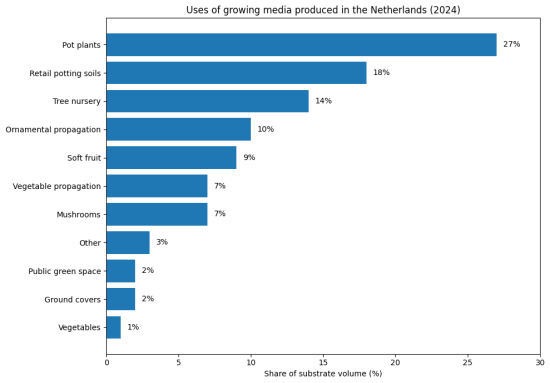
Let’s first consider the argument that peat is feeding the world. Food production is unquestionably an essential use. Growing media are used for vegetable seedlings, soft fruit, mushrooms and some greenhouse crops. If peat were indispensable to these applications, that would be a serious argument for retaining at least some horticultural peat use. However, peat has been shown to be replaceable for most food types, as frontrunners in the UK and Switzerland consistently show.[2] How large is the market share of food production within the substrate market? The Dutch substrate industry’s own figures indicate the scale: food-related applications account for a mere 24% of substrate volume, less than a quarter.[3]
[2] Gov.uk: Impact of a proposed ban of the sale of horticultural peat in England, https://www.gov.uk/government/publications/report-impact-of-a-proposed-ban-of-the-sale-of-horticultural-peat-in-england-on-the-effective-operation-of-the-uk-internal-market/impact-of-a-proposed-ban-of-the-sale-of-horticultural-peat-in-england
[3] In this article, we refer to Dutch figures, because they are the most fine-grained. Most other markets differ in that they have a larger retail market compared with professional users. VPN’s annual 2025 report:
https://www.devpn.nl/assets/files/factsheet-sector-en-vpn-update-def-oktober-2025-v2b.pdf
Do we need substrates to green our cities?
What about the second argument, that growing media are greening the cities? Again, there is a grain of truth to this argument. For climate adaptation and general well-being, having lots of plants around you is certainly a good idea. When green spaces are expanded, it’s convenient to be able to buy plants off the shelf. However, is that where most of the growing media are used?
The industry’s own figures again put this argument into perspective. In the Netherlands, public green space accounts for just 2% of substrate production. By contrast, pot plants alone account for 27%, ornamental propagation for another 10%, and packaged growing media sold through retailers for 18%.[3]
Growing media can therefore contribute to urban greening. But urban greening cannot plausibly explain most current demand for growing media.
What about forests?
Forest expansion and restoration are another potentially important use of growing media. But here too, we need to distinguish scale and necessity. Around 74% of EU forest area originates from natural regeneration or natural expansion rather than planting or seeding.[4] Natural regeneration can also support locally adapted trees and genetic diversity. Planting nevertheless remains important where new forests are established or after major disturbances. The remaining 26% of forest areas not regenerated naturally are planted with bare-root trees, requiring no substrates, or with substrates.
[4] State of Europe’s Forests 2025, Ministerial Conference on the Protection of Forests in Europe: https://aifm.org/wp-content/uploads/2026/04/SoEF2025.pdf p.115
Growing media can be important without peat being a critical resource
Some uses of growing media clearly serve essential purposes, including parts of food production, forest restoration and urban greening. But these essential applications account for only a minority of the market. In the Dutch industry’s own figures, food-related applications account for around 24%, while public green space accounts for 2%. Much larger shares go to pot plants, ornamental horticulture and retail growing media.
Nor does the importance of an application demonstrate that peat itself is indispensable. Peat alternatives already exist and are used commercially, although their suitability and environmental impacts vary considerably between applications. The relevant policy question is therefore not whether growing media are useful. Clearly they are. It is whether protecting continued access to peat, including new extraction, is necessary for those societal functions that genuinely depend on growing media. In our view, no new peat extraction sites are necessary to feed us and to green our cities.
Calling growing media essential is not evidence that peat is a critical resource.
This text was written by Dr. Philipp Gramlich, Stichting Turfvrij, 30 September 2026. For questions about the content, please contact us.

